IRCTC Bike Parcel Service: Booking Process, Charges and Required Documents
Moving to another city, studying away from home or relocating for work can create a practical problem: how do you take your motorcycle or scooter with you? Indian Railways provides a two-wheeler transportation facility that allows eligible motorcycles and scooters to be carried by train. Despite often being searched as the “IRCTC bike parcel service,” the physical booking and handling of a motorcycle is primarily an Indian Railways parcel/luggage service, rather than a normal IRCTC passenger e-ticket feature.
A two-wheeler can generally be transported in two ways. If you are travelling on the same train, it may be booked as luggage subject to the applicable rules. If you are sending the vehicle without travelling with it, it can be booked as a parcel between stations that handle parcel traffic.
| Bike Transport Information | Details |
|---|---|
| Service | Indian Railways Parcel/Luggage |
| Vehicles | Motorcycles, scooters and eligible two-wheelers |
| Parcel Booking | Passenger need not travel with vehicle |
| Luggage Booking | Used when passenger travels with vehicle |
| Booking Location | Railway parcel/luggage office |
| Main Form | Forwarding Note |
| Charges | Depend on weight, distance and applicable railway rate |
| Free Luggage Allowance | Not applicable to scooters/cycles |
| Packing | Required for safe transportation |
| Fuel | Petrol must be removed as required |
| Vehicle Details | Registration number, make, weight/value etc. recorded |
| Delivery | At destination parcel/luggage office |
Is Bike Parcel Booking Done Through IRCTC?
Passengers commonly call it IRCTC bike parcel booking because IRCTC is strongly associated with railway reservations. However, two-wheeler transportation is handled under the Indian Railways parcel and luggage system.
Railway parcel offices handle acceptance, weighing, documentation, charging and delivery of consignments.
Indian Railways has also digitised significant parts of its Parcel Management System (PMS). Facilities include online forwarding-note generation for registered customers, fare estimation, parcel-space information, barcode tracking and SMS updates at supported locations.
The actual motorcycle still has to be presented at the railway parcel/luggage office for the required physical processing.
Two Ways to Transport a Bike by Train
Understanding the difference between parcel and luggage is the first step.
Bike as Parcel
Choose parcel booking when the motorcycle needs to be transported to another station but you are not travelling with it on the same train.
The vehicle is accepted as a railway parcel and transported according to parcel availability and operating arrangements.
The bike does not necessarily travel on the same train or at the same time as you.
Bike as Luggage
If you are travelling by train and want the motorcycle transported in connection with your journey, it can be booked under the applicable luggage rules.
Indian Railways states that luggage intended to travel on the same train as its owner should be presented at the luggage office at least 30 minutes before the advertised departure time. Passengers with advance reservations are also permitted to book luggage in advance.
For a motorcycle, however, arriving substantially earlier than the minimum is sensible because packing, documentation, inspection and loading arrangements require additional processing.
Documents Required for Bike Parcel Booking
Keep the vehicle and identity documents ready before going to the parcel office.
The exact documents requested should be confirmed with the booking station, but the process normally requires information establishing the vehicle and the person booking it.
Important documents/details can include:
Vehicle Registration Certificate (RC) – Carry the vehicle’s registration information and the original/copy as required by the booking office.
Government-issued identification – Keep acceptable identity proof of the person making the booking.
Journey ticket/PNR – Required where the motorcycle is being booked as luggage in connection with your own train journey.
Forwarding Note – This is an important railway document completed for the consignment.
Indian Railways’ two-wheeler instructions state that the Forwarding Note records information including the originating station, destination station, postal address, make of vehicle, registration number, vehicle weight and declared value.
Requirements can be updated or applied according to the circumstances of the booking, so verify the documents at the originating parcel office before transporting the vehicle there.
What Is a Forwarding Note?
The Forwarding Note provides Indian Railways with the information required to accept and transport the consignment.
For a two-wheeler, it records identifying information about the vehicle and the shipment.
Indian Railways’ commercial rules require railway staff handling an unpacked motorcycle to examine details such as the manufacturer’s trade name, vehicle number, condition and detachable fittings and ensure that relevant particulars are recorded on the Forwarding Note and waybill.
This documentation helps identify the motorcycle throughout the transportation process.
How to Book a Bike as a Railway Parcel
The practical process begins at a station equipped to handle parcel traffic.
Step 1: Confirm That Both Stations Handle Parcels
Not every small railway station necessarily provides the required parcel-booking facility.
Indian Railways states that parcels can be booked only from and to stations that are open for parcel traffic.
Confirm this before taking your motorcycle to the station.
Step 2: Take the Bike to the Parcel Office
Bring the motorcycle to the railway parcel office according to the booking office’s operating hours and instructions.
Parcel-office hours can vary by station or Railway division, so do not assume every parcel office follows identical timings.
Step 3: Prepare the Motorcycle
The motorcycle needs to satisfy Railway transportation and packing requirements.
Indian Railways requires parcels to be securely packed so that they can withstand normal handling and transportation.
For two-wheelers, the parcel office or authorised packing providers around major stations may assist with protective packing.
The aim is to protect vulnerable areas of the motorcycle during loading, movement and unloading.
Step 4: Remove Petrol
Petrol is an inflammable substance and cannot be transported as ordinary railway luggage/parcel.
Indian Railways’ luggage rules prohibit dangerous and inflammable articles from being booked as luggage.
Follow the parcel office’s instructions for presenting a fuel-powered motorcycle for transportation. Do not leave petrol in the vehicle contrary to railway requirements.
Electric motorcycles and scooters can be subject to separate rules because of their lithium-ion batteries. Indian Railways has issued specific instructions covering transportation of electric two-wheelers equipped with lithium/lithium-ion batteries.
Owners of electric vehicles should therefore confirm the current battery and packing requirements directly with the railway parcel office before booking.
Step 5: Complete the Forwarding Note
Provide the required sender, recipient and vehicle information.
Indian Railways’ two-wheeler guidance identifies details such as:
- Originating station
- Destination station
- Postal address
- Vehicle make
- Registration number
- Vehicle weight
- Vehicle value
as information entered in the Forwarding Note.
Check all identifying information carefully before submitting it.
Step 6: Vehicle Inspection and Weighment
Railway staff can inspect the motorcycle and its identifying details.
The parcel is then processed according to applicable weight and railway tariff rules.
Indian Railways states generally that parcels should be weighed in the presence of the sender or authorised representative.
Step 7: Pay the Applicable Charges
Once the booking details, distance and chargeable weight are determined, pay the amount calculated by the railway booking system.
Keep the railway receipt or luggage ticket safely.
It is important for tracking and collecting the vehicle at the destination.
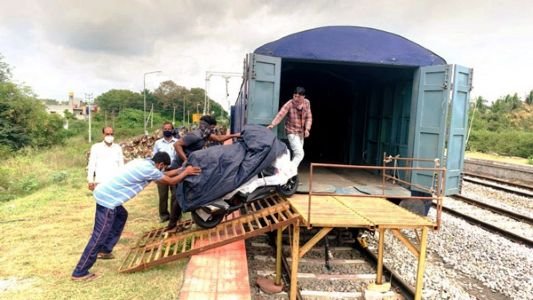
Step 8: Railway Loading and Transportation
After booking, the motorcycle enters the Railway parcel/luggage transportation process.
A parcel shipment should not be assumed to travel on the same passenger train as the sender. Loading depends on available parcel space and railway operating arrangements.
Indian Railways’ Parcel Management System provides digital tracking and SMS status updates at supported locations, including information connected with booking, loading, unloading and delivery.
How Much Does It Cost to Transport a Bike by Train?
There is no single flat bike parcel price for all Indian Railways journeys.
The charge depends on factors such as:
Distance travelled
Chargeable weight
Parcel/luggage rate applicable to the movement
Type of booking
Applicable packing costs
Other applicable railway charges
Indian Railways states that parcels are charged according to weight or measurement, whichever produces the higher applicable charge.
Parcel rates can also be revised. Indian Railways issued a further rationalisation of rates for parcel and luggage traffic in May 2026, demonstrating why an old fixed-price chart should not be used to estimate a current motorcycle shipment.
The most reliable amount is therefore the fare estimate/current charge generated for the exact origin, destination and motorcycle at booking.
Is a Motorcycle Covered by the Free Luggage Allowance?
No.
The ordinary free luggage allowance associated with passenger travel should not be applied to a motorcycle.
Indian Railways specifically states that free allowance is not admissible for articles such as scooters and cycles.
Therefore, even if you are travelling on the same train and have a passenger luggage allowance, you should expect the two-wheeler to be separately charged under the applicable rules.
Does Bike Weight Affect the Parcel Charge?
Yes.
Weight is one of the important components used in railway parcel charging.
The motorcycle’s weight is included in the booking information, and Indian Railways parcel rules provide for weighing consignments as part of the acceptance process.
Do not rely solely on the kerb weight found online to calculate an exact charge yourself. The chargeable weight and final railway tariff are determined through the booking process.
Are Packing Charges Included?
Do not assume that packing is included in the Railway transportation fare.
If packing is provided separately by an outside packing service, its charge can be additional to the railway parcel charge.
Ask for the costs separately so you know which amount represents the official railway transportation charge and which amount relates to packing or another service.
How to Track a Bike Parcel
Indian Railways has introduced digital tracking through its Parcel Management System.
The system includes barcode-based parcel tracking and status updates. Indian Railways states that customers can receive SMS updates at stages including booking, loading, unloading and delivery when their shipment is processed through the relevant PMS facilities.
More recent Railway information also confirms barcode generation and scanning for parcels at parcel offices operating through PMS, improving tracking of consignments during loading and unloading.
Keep your railway receipt and booking information until the motorcycle has been collected.
How to Collect the Bike at the Destination
Once the motorcycle reaches the destination station and becomes available for delivery, visit the parcel office.
Indian Railways’ parcel guidance states that the recipient should produce the relevant Parcel Way Bill/railway receipt, pay any additional charges that are due and check the condition of the parcel when receiving it.
Collect the motorcycle promptly after receiving arrival information.
Leaving a parcel at the destination beyond the permitted period can result in additional charges under Railway rules.
Inspect the vehicle at the time of delivery rather than waiting until after leaving the railway premises to notice an obvious transportation issue.
Declaring the Value of the Motorcycle
The declared value deserves attention because it can affect Railway liability if a consignment is lost or damaged.
Indian Railways states that where the value of booked personal luggage has not been declared and the prescribed percentage charge has not been paid, Railway monetary liability is limited according to the applicable rules. Its current passenger luggage information cites a limit of ₹100 per kg for personal baggage where value has not been declared in the prescribed manner.
Where the consignor declares the value and pays the prescribed percentage charge, different liability provisions can apply.
Ask the parcel booking office about value declaration when booking a higher-value motorcycle rather than assuming its full market value is automatically covered.
Bike as Parcel vs Bike as Luggage
The choice depends primarily on whether you are travelling with the motorcycle.
| Feature | Bike as Parcel | Bike as Luggage |
|---|---|---|
| Passenger must travel | No | Yes |
| Passenger train ticket needed | Not for parcel shipment itself | Required for associated journey |
| Same train guaranteed | No | Intended to accompany passenger, subject to railway arrangements |
| Booking point | Parcel office | Luggage/parcel office |
| Charges | Parcel tariff | Applicable luggage tariff |
| Vehicle documents | Required as applicable | Required as applicable |
| Railway receipt/luggage ticket | Yes | Yes |
If your only goal is to send the motorcycle to another city, parcel booking is generally the relevant category.
If you are travelling yourself and want the motorcycle carried in connection with that journey, ask the luggage office about booking it as luggage.
Frequently Asked Questions
Q1. Can I send my bike by train without travelling?
A. Yes. A motorcycle can be booked as a parcel when the owner is not travelling with it. The vehicle must be accepted at a station open for parcel traffic, properly prepared and documented, and the applicable parcel charges must be paid.
Q2. What documents are required for railway bike parcel booking?
A. Keep the motorcycle’s registration details/RC, acceptable identification and the information needed for the Railway Forwarding Note. If the bike is being booked as luggage with your own journey, keep the relevant railway ticket/PNR as well. The Forwarding Note records details such as origin, destination, addresses, vehicle make, registration number, weight and value.
Q3. How much does IRCTC charge for bike parcel booking?
A. There is no universal fixed charge. Railway transportation cost depends on factors including the motorcycle’s chargeable weight, distance and applicable parcel or luggage tariff. Packing or other services can add separate costs. Current rates should be checked for the exact stations and vehicle rather than relying on an old online price chart.
Q4. Can I transport a bike with petrol in the tank?
A. Petrol is inflammable, and Indian Railways prohibits inflammable articles from ordinary luggage transportation. A fuel-powered motorcycle must therefore be presented according to the parcel office’s fuel-safety requirements. Electric two-wheelers have separate Railway instructions concerning lithium/lithium-ion batteries, so their current acceptance conditions should be confirmed before booking.
Q5. How do I collect my bike after it reaches the destination?
A. Go to the destination parcel office with the relevant railway receipt/Parcel Way Bill and required identification. Pay any outstanding applicable charges, complete the delivery formalities and inspect the motorcycle’s condition before taking delivery.